LAURA BERGER
Future Art Fair
New York
May 10 – 13, 2023



Within
the context of the desert, Laura Berger’s paintings are the phantasmic sister of
the mirage, which the motif of the veil presents and conceals. Through the
application of thin layers of oil paint the artist renders a sensual transparency
– the lyrical wisps of colour that envelope and shroud a secret image.
Hailing from the Latin ‘desertum’, the desert is the ‘abandoned place’ par excellence. This implies it is not only an environment where nothing can grow; it is a place that may have been inhabited, but is now emptied or vacated. The abandoned is not just that which remains or is leftover in the wake of the departed, but also carries the suggestion of the once-loved cast aside to ruination or neglect. What does it mean to return to the abandoned place after time, what species of phantasm occupies it?
Much like Arthur Dove’s stylised depictions of landscapes, Berger cedes representation to potentialise the emotional or psychical states that alight from the scenes, the sinewy quality of the paint, a specific choice of palette. As such, even a simple painting of figures traversing the desert [Desert Walking] anticipates a hidden complexity about the artist herself. The repetition of the figure in this work infers lapses of suspended time while accentuating its movement: the multiplied past, present and future selves that listlessly wander a purgatory. She is victim of the hallucinatory effect of the desert, in as much as she is the subject of an Eadweard Muybridge movement study. And yet, in other works, small areas of consistency and compositional symmetry allude to a much different nature of time [Hot Springs]. The patterning reads as geological striations – solidified accretions that bear witness to the passage of epochs, an anchor to Earth against the effervescent temporality of veils.
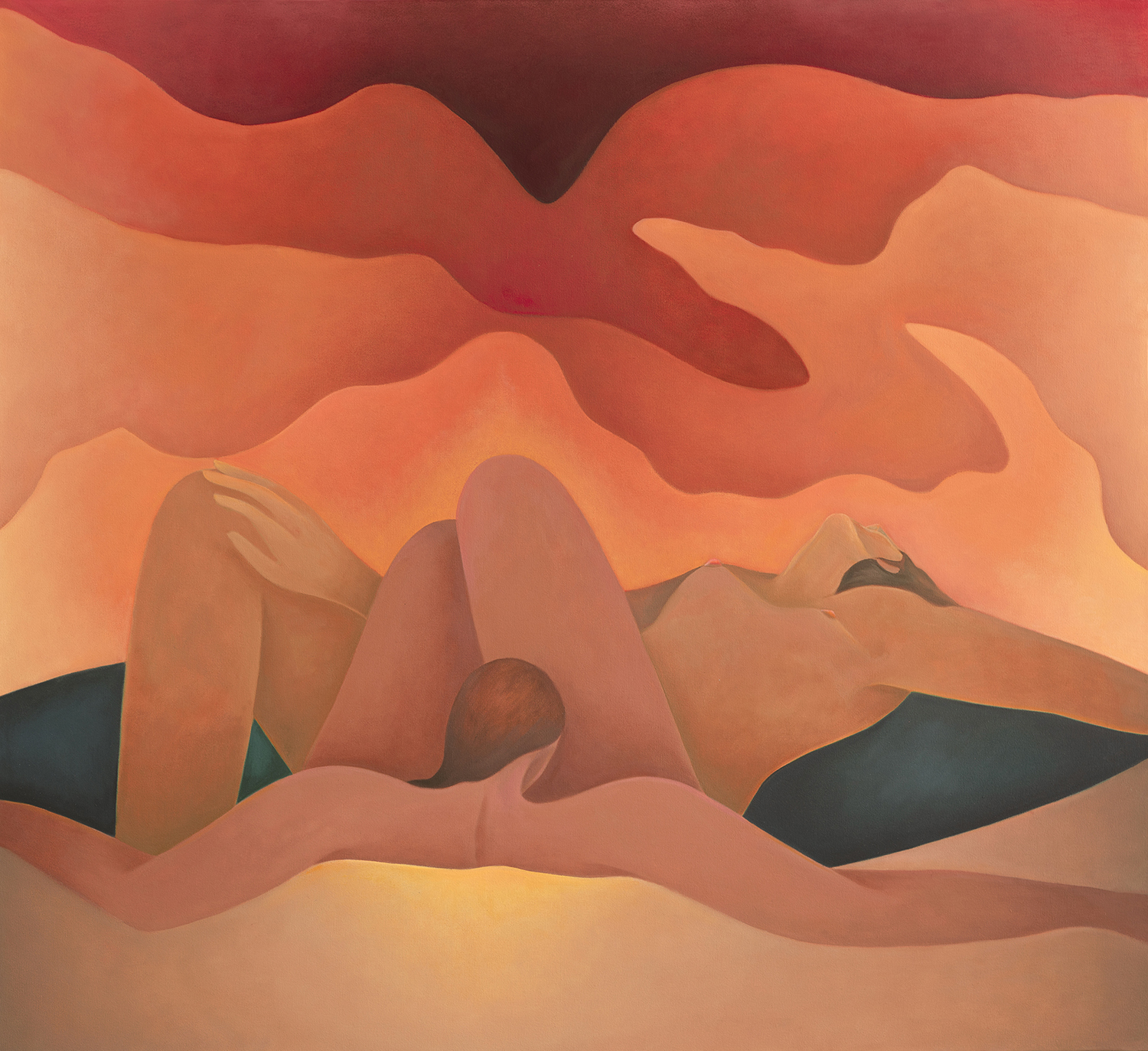
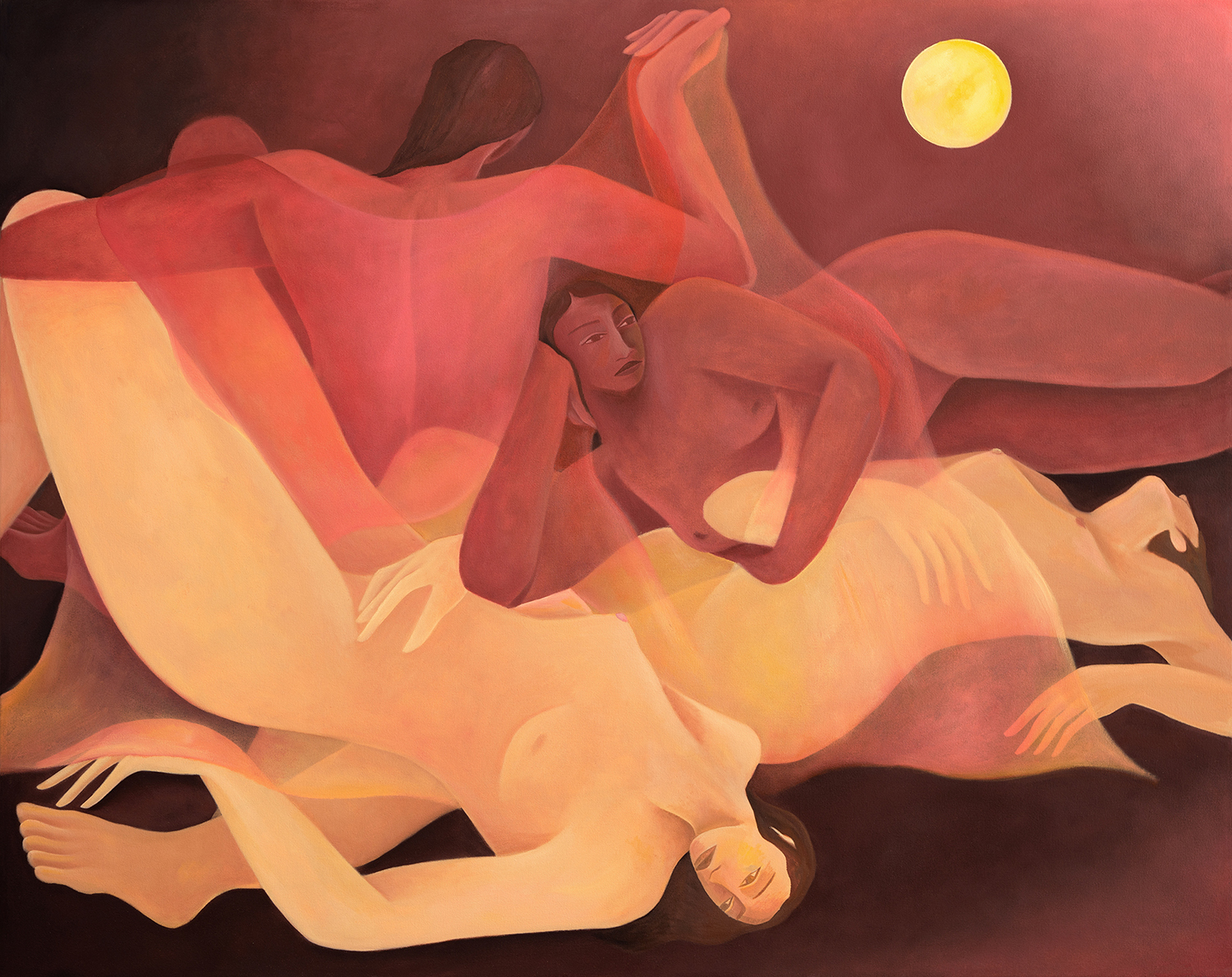
The desert arrives at its abandonment through the sum of geological processes that are together referred to as ‘denudation’. Denudation – to make nude, endure stripping and weathering – draws parallel between the literal landscape and the metaphorical figure, but is also particular to the creation of the desert’s beauty and form. In archaic psychology, knowledge is delivered through the medium of a phantasm, whose true image the faculty progressively bares or denudes with the crepuscular light of revelation [Morning Light]. As if offering confirmation or consolation about this, one figure appearing in the upper-left corner prises away the ‘fourth wall’ of the painting; desert winds as veil-ribbons billow from her hands, bisecting the canvas plane and shielding her sisters from the sun [Shademaker]. Berger’s figures are charged with the ambivalence of desert denudation; this is no where more apparent than the group of art history’s beloved reclining nudes that reminisce amorphous dunes [Reflector].
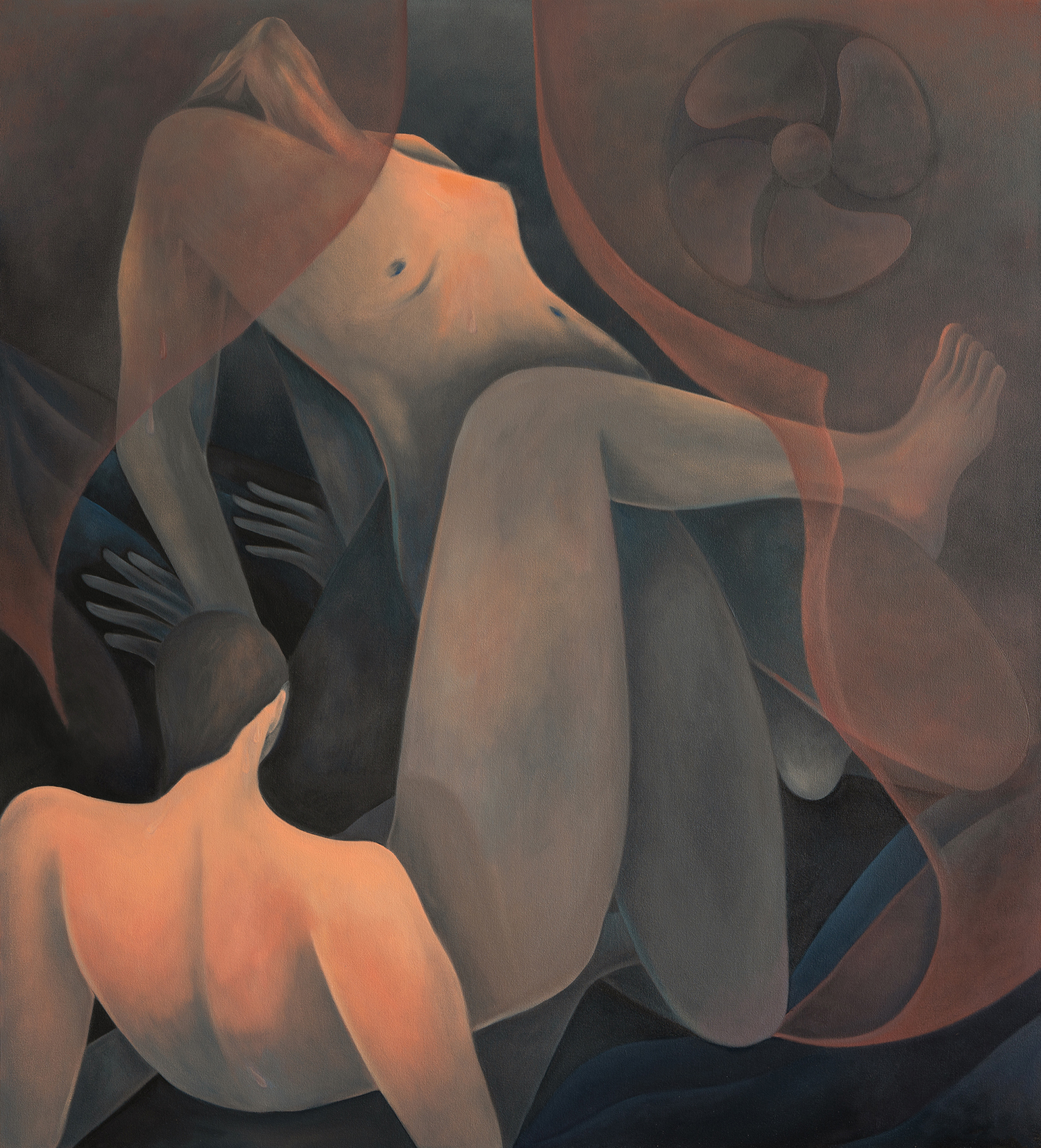
In one painting, a figure indulges in the comfort of the heat, well acclimated. Elsewhere, she contorts in existential agony, a fever vision writhing beneath her skin [Night Sweats]. To inhabit the desert demands special adaptation, long periods of dormancy or even nocturnality. Should the veil protect us from knowing fully the secret image, then the phantasm is what must detach from the body of reality, to sacrifice itself to the dream.
The artist’s new work is situated in and by the desert because she seeks that which is off limits to consciousness, the non-place of a Giorgio de Chirico that the memory may be troubled to touch. For Berger’s impulse to paint issues from the possibility of something where there is nothing, be as it may that the artist was first moved to paint following a series of incalculable personal losses. Within the context of the desert Berger’s mirage-like artworks swaddle us with its imagined allure – it offers us the miracle of what could be in spite of the desert of the real.
- Elaine ML Tam, May 2023
Hailing from the Latin ‘desertum’, the desert is the ‘abandoned place’ par excellence. This implies it is not only an environment where nothing can grow; it is a place that may have been inhabited, but is now emptied or vacated. The abandoned is not just that which remains or is leftover in the wake of the departed, but also carries the suggestion of the once-loved cast aside to ruination or neglect. What does it mean to return to the abandoned place after time, what species of phantasm occupies it?
Much like Arthur Dove’s stylised depictions of landscapes, Berger cedes representation to potentialise the emotional or psychical states that alight from the scenes, the sinewy quality of the paint, a specific choice of palette. As such, even a simple painting of figures traversing the desert [Desert Walking] anticipates a hidden complexity about the artist herself. The repetition of the figure in this work infers lapses of suspended time while accentuating its movement: the multiplied past, present and future selves that listlessly wander a purgatory. She is victim of the hallucinatory effect of the desert, in as much as she is the subject of an Eadweard Muybridge movement study. And yet, in other works, small areas of consistency and compositional symmetry allude to a much different nature of time [Hot Springs]. The patterning reads as geological striations – solidified accretions that bear witness to the passage of epochs, an anchor to Earth against the effervescent temporality of veils.
The desert arrives at its abandonment through the sum of geological processes that are together referred to as ‘denudation’. Denudation – to make nude, endure stripping and weathering – draws parallel between the literal landscape and the metaphorical figure, but is also particular to the creation of the desert’s beauty and form. In archaic psychology, knowledge is delivered through the medium of a phantasm, whose true image the faculty progressively bares or denudes with the crepuscular light of revelation [Morning Light]. As if offering confirmation or consolation about this, one figure appearing in the upper-left corner prises away the ‘fourth wall’ of the painting; desert winds as veil-ribbons billow from her hands, bisecting the canvas plane and shielding her sisters from the sun [Shademaker]. Berger’s figures are charged with the ambivalence of desert denudation; this is no where more apparent than the group of art history’s beloved reclining nudes that reminisce amorphous dunes [Reflector].
In one painting, a figure indulges in the comfort of the heat, well acclimated. Elsewhere, she contorts in existential agony, a fever vision writhing beneath her skin [Night Sweats]. To inhabit the desert demands special adaptation, long periods of dormancy or even nocturnality. Should the veil protect us from knowing fully the secret image, then the phantasm is what must detach from the body of reality, to sacrifice itself to the dream.
The artist’s new work is situated in and by the desert because she seeks that which is off limits to consciousness, the non-place of a Giorgio de Chirico that the memory may be troubled to touch. For Berger’s impulse to paint issues from the possibility of something where there is nothing, be as it may that the artist was first moved to paint following a series of incalculable personal losses. Within the context of the desert Berger’s mirage-like artworks swaddle us with its imagined allure – it offers us the miracle of what could be in spite of the desert of the real.
- Elaine ML Tam, May 2023
ABOUT THE ARTIST
LAURA BERGER is a contemporary artist living and working in Chicago. Centered around themes of interdependence and self-understanding, her images focus on figurative archetypes, intuitive color palettes and dreamlike minimalistic environments. Initially approaching painting as a therapeutic practice, her work serves as a means through which to explore and articulate experiences and memories that feel just out of reach, that exist on a more spiritual or emotional plane.